

Of Fake Jews and Mandatory Prostitution
Putting Revelation back in its context

*Disclaimer. Insincerity is by no means confined to one religion or group of people. As you will you see, it is not a “Jewish” or “Christian” (or otherwise) condition. Rather, it is, as the Bible teaches, a very human condition.*
In a previous article, we went over the difference between the Antichrist (as explained in 2 John), and the Beast of St. John’s Revelation. Whether one “believes” in these archetypal figures or not is irrelevant. What matters first is to understand what the biblical writers meant by what they said.
In reality, both of these figures are archetypal — that is, they had an immediate fulfillment/manifestation in John’s own day, but they also recur throughout history (including to even in our day). The “beast” was likely fulfilled in the person of Caesar Nero (and possibly also in Caesar Domition), who persecuted Christians like John the apostle — exiling him to Patmos in the Aegean Sea. And “Antichrists” were those false prophets (or insincere “Christians”) who claimed to follow (or actually be) the “Messiah” (that is, to truly walk in love), but in reality just had opportunistic or political motivations.
But there are many other enigmatic figures/archetypes that appear in Revelation. Not just beasts and antichrists, but also seals, trumpets, dragons, “stars falling from the sky”—beasts with many heads, and birds “gorging on flesh”—indeed, there’s no shortage of visceral display that have fascinated (and freaked out) readers for 2 millennia. But of all these frights, one of the most disturbing has got to be the famous description of “the Whore of Babylon”. In Revelation 17:1-2, John wrote:
“One of the seven angels…said to me, ‘Come, I will show you the punishment of the great prostitute, who sits by many waters. With her the kings of the earth committed adultery, and the inhabitants of the earth were intoxicated with the wine of her adulteries’.”
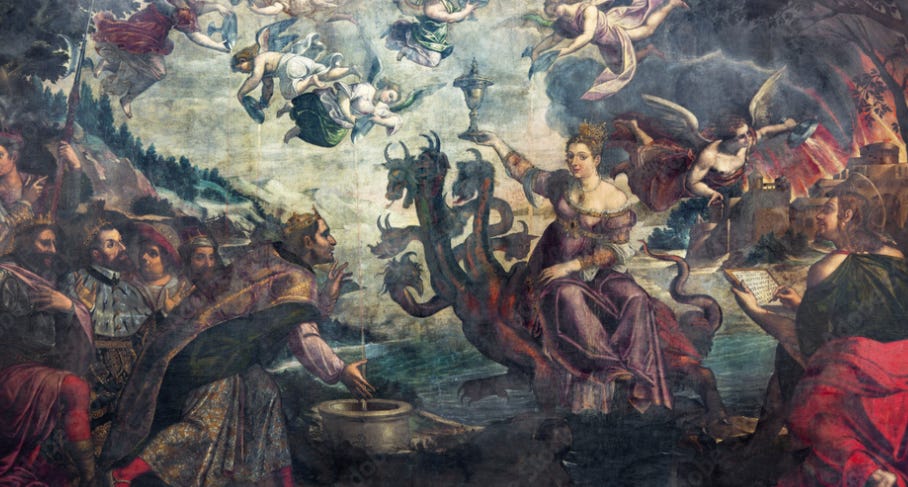
The Old is in the New
When it comes to Revelation, the most important thing to know right away is that the whole book is steeped in what modern Christians call the “Old Testament” — that is, infused with the Torah and the Prophets,and all their apocalyptic allegory and imagery. One of the biggest reasons Revelation has confused so many (and often appears like a crazy acid trip), is because people are not aware of the imagery and motifs that dominated the imagination of ancient peoples. Often, the images in Revelation (and the rest of the Bible) were not even unique to Israel — many were known throughout the ANE (Ancient Near East).
But before we get to this particular “harlot” of John’s letter, we first need to familiarize ourselves a little bit with Ancient Babylonia (from Israel’s perspective) — what was this place?
Essentially, the ancient city of Babylon was for ancient Israelites (a nation of people dedicated to Yahweh alone) everything that they were not supposed to be. Aside from the fact that Israel had originally set itself apart from all nations by its (very strange) worship of only one god (and other strange things, like caring about the poor, and performing customs/rites, like circumcision) — and in this way they were to be different from everyone — the powerful polytheistic nation of Babylonia (and it’s capital city, Babylon) would eventually become famous for its moral and sexual depravity (particularly in the eyes of the Israelites). When other nations like Israel would see these extremely animistic cultures, it would naturally bring to the surface a fear of chaos.
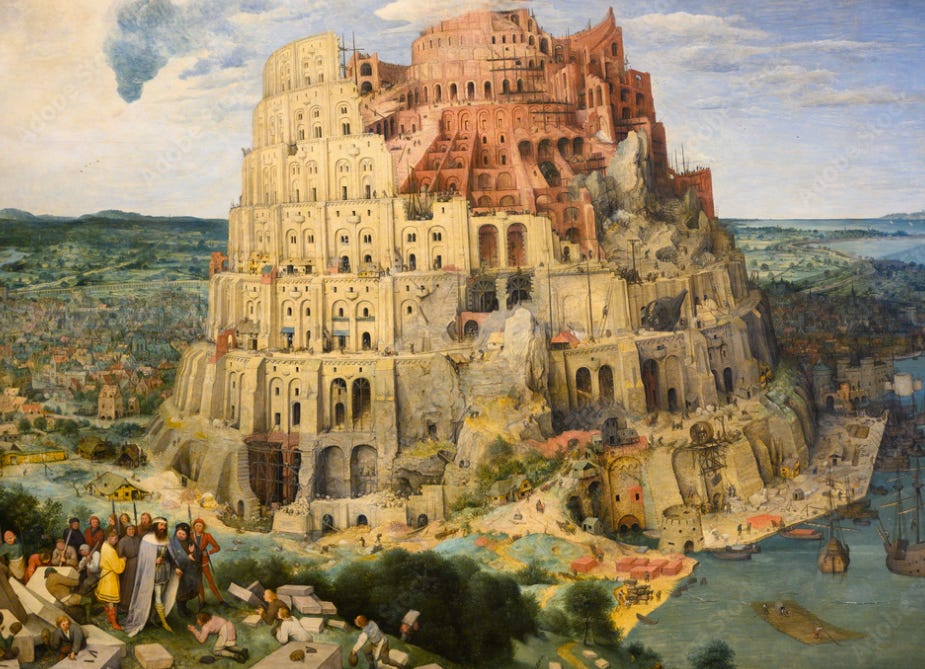
Indeed, Jews who knew their Torah would have likey associated the story of the Tower of Babel—“Babel” associated with “babble” or confusion, i.e. The Tower of Babylon, The Tower of Confusion—with Babylonia in general.
Animism and Honor/Shame Culture
More than just moral decay and confusion, though, it is important to consider the basic social reality of ancient animism in general (which “Israel” defined itself against). Not just polytheism (worship of many gods) — but animism, which wikipedia describes as:
“…the belief that places, objects, and creatures all possess a distinct spiritual essence. Animism perceives all things—animals, plants, rocks, rivers, weather systems, human handiwork, and in some cases words—as being animated, having agency and free will. Animism is used in anthropology of religion as a term for the belief system of many indigenous peoples in contrast to the relatively more recent development of organized religions.”
This is an overly simplistic definition (animism varied greatly between nations, and it was really a spectrum between extremes), but it’s important to start with the general idea first.
Chapter 5 in my book, The Vital Villain, is the longest of all the chapters. It walks through the classic story of the Exodus from Egypt. But instead of just recounting all the miraculous events (as most people do), I look at the Exodus through the lens of the competition of the gods — that is, how Israel used animistic/polytheistic Egypt to sharply clarify for itself everything that it was not going to be. Yes, the honor and shame background of the Exodus is actually the key feature of the ancient world (not divine miracles themselves) that has been sorely lacking in Bible interpretation in modern times. Here is a screenshot of one of the pages from the book, which features an orderly layout of the 10 plagues:
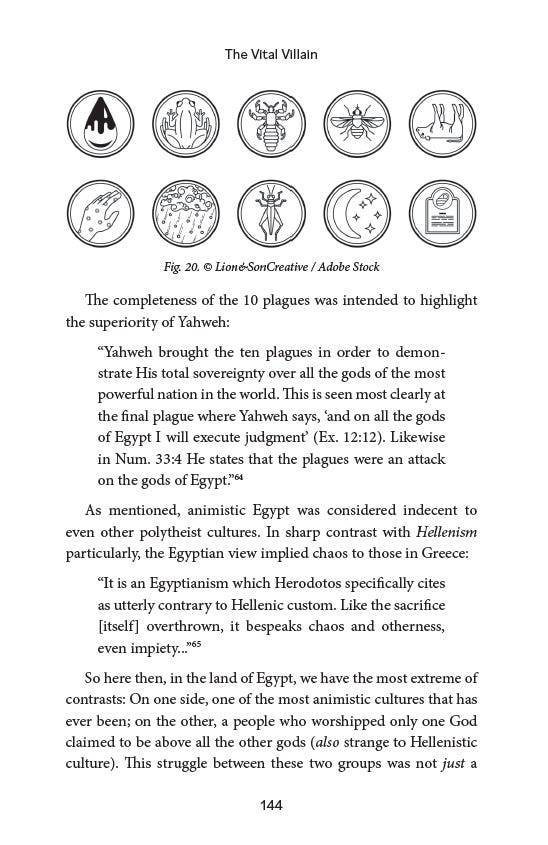
Did you catch that part where Yahweh says:
“…on all the gods of Egypt I will execute judgment.” (Exodus 12:12)
I was lucky to grow up with some really great movies as a young man. But as much as I loved epics like Prince of Egypt by Dreamworks (which beautifully recounted the Exodus story through the lens of the brotherly relationship between Moses and Ramses), I can see now that even great epics like this didn’t really reveal how, when Yahweh crushed the Egyptians, he also crushed their world-view — that is, their gods, their ethos, and their pride. Instead of just, “Oh cool, Moses parted the sea!”, as if the physical miracles were all that mattered to ancient peoples — indeed, I grew up in a context that only debated the historicity of events, not asking about the honor/shame implications of those events — the Exodus was intended to repudiate Egyptian animism in general. And not just repudiation, but a grand, public humiliation ritual.

Yes, in the same way that modern people have lost touch with how the shame of crucifixion was actually worse than its pain, so also we have lost the sense of the horrific shame and humiliation that Egypt (and their gods) would have felt during the 10 Plagues and the momentous defeat and deluge at the Red Sea Crossing. Yes, in order to understand the significance of Revelation in general (its themes and archetypes), one first needs to go back in time to the original Exodus and look at it through the lens of honor and shame, as I spell out very carefully in my book.
Animistic Animal Worship Vs Monotheist Sacrifice
But why judge and humiliate Egyption animism to begin with? Was it really that bad?Well, what you think about ancient Egypt (and other animistic nations, like Babylonia) will depend on your pressupositions and what you consider to be “good”—that is, your values. No doubt if you are a modern western person living in a “democracy” in suburbia somewhere — if you were taken back in time and dropped into “animistic” cultures like Egypt, you would likely be fascinated, but also horrified at what you saw. You would probably want to come back to modernity pretty quick.
Is this because you would think Egyptian animism was “bad”? Maybe. But moreso it would just be something that was so incredibly alien to you. Yes, for all our modern “secular” pretensions, “religion” (or “religio”) for the ancients was about so much more than what you “believe”—rather, it was about how you lived.
Most ancient nations were polytheistic, and they tended to look down on those who only worshipped and followed one god, like the Jews (and the Zoroastrians before them). The most “normal” way of life in the ANE (Ancient Near East) was:
a vision of the pantheon of gods where sacrifices were made to various deities at certain stages and events of life to mark their importance and memory.
NOT the more ancient animism that was typical of Egypt, where sacrifice of any kind was forbidden, because all creatures were worshipped as divine.
To quote again from the same page mentioned above, Hellenism (dominant at the time of Jesus) considered Egyption “religion” (“religo”) indecent and impious—even inviting chaos, as Herodotos mentioned:
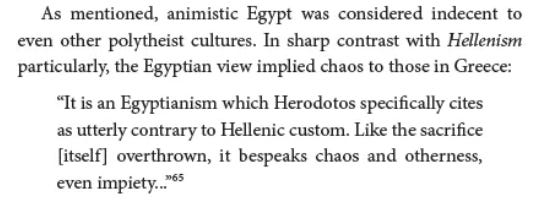
It is interesting that the Greek Herodotos mentions the chaos of Egyptian animism specifically — indeed, most of the gods (especially sky deities) of the ancient world were associated with order, and so to go out of your way to create chaos was considered (almost everywhere) an affront to the gods; it was something that could put you on their “kill-list” if you weren’t careful. From Herodotus’s perspective, Egyptian (and probably also Babylonian) animism (deifying every object in nature) was an affront to the gods of the pantheons of most other nations. Although Babylon did offer sacrifices (unlike Egypt), they were certainly far more “animistic” than other nations like Greece, Rome, and Israel.
So when the “Jews” (Israelites) considered the Egyptian and Babylonian way of thinking strange, they certainly were not alone in that perspective. But out of all the nations, “Israel” (meaning, to struggle with just one God) probably looked down on Egypt and Babylonia the most. And this is likely why the “Tower of Babel” (Babylon) is featured highly in the Torah — the chaos that resulted at the end of the story of “Babylon” trying to work together to build a tower to the sky — would have resonated with Jewish readers who already looked down on Babylonia as chaotic and impious. When Israelites read the story of the “Tower of Babel”, they likely would have thought… “See, Babylon, I told you so!”
But to Hellenic people, both of these views — monotheism and animism — were considered extreme. But in the Exodus from Egypt, it was precisely these two opposite viewpoints who had come face-to-face against each other in the grand Bible story. And it was the Israelite vision of worshipping only one God, YAHWEH, that had utterly triumphed, leaving in its wake of devastation and humiliation the gods of Egypt — a display that, although a Greek or a Roman would appreciate seeing animism have its compeuppance, would have still yet been bothered by the monotheism of Israel after its triumph (although at least the chaos that animism represented had been routed).
And it was precisely this sharp contrast (between world-views) that had been intended to underline the founding principle of the nation of Israel. The gods of Egypt had been utterly humiliated, so — in its very founding, that is, by definition — Israel was NOT supposed to be like them. This is why the 10 Commandments started with a reference to the triumph out of Egypt:
“And God spoke all these words:
‘I am the LORD your God, who brought you out of Egypt, out of the land of slavery. You shall have no other gods before me.’” (Exodus 20:1-3)
But as the famous grand story of the Bible would show, sticking to just one god (out of a myriad that seemed to everyone to be abundantly available) would become increasingly difficult. It was very natural for most peoples to worship many gods (with all their images/idols) — which seemed to be everywhere. This is why the rest of the Torah (and prophets) would regularly appeal to the superiority and supremacy of Yahweh that had been clearly shown in the Exodus. Yes, even long after Pharaoh’s demise, his memory was still vital.
A Jealous God? - Yahweh as Lover
To ancient peoples, the idea that you could love or be loved by a god was extremely strange. Worship and placate the gods? Certainly. Try to avoid their wrath and make sure they don’t shame and kill you? Absolutely.
But to love a god?—and be loved by a god? Unheard of. Insane, really. At the beginning of The Vital Villain, it quotes a feminist author from the 1980s who, quite remarkably, clearly understood this about the perspective of ancient peoples in general—particularly Rome:
“The gods live in the sky above, where Father Zeus maintains his patriarchal sway among the clouds. At times these gods intervene in human affairs, even taking sides on the battlefield, but they never involve themselves in the inner emotional life of human beings. They are prayed to or avoided because they are powerful and can influence the outcome of a battle or the course of the weather. They are never loved.”
But this is precisely the character of Yahweh that had been revealed to Moses and to “Israel”—a god who did involve himself in the “inner emotional life of human beings”. What a shock to the ancient world! What a strange thing…
But along with this loving character of Yahweh came a distinct quality that other gods would not be known to show in the same way: Jealousy.
For most gods, if you went against their wishes or offended them in any way, you could easily be struck down and turned to ash (not to mention, humiliated). But would that particular god feel emotionally offended that you didn’t LOVE them? That you, in fact, showed careless disregard for their “love”?
Not at all. That was a not a thing.
It was only in Israel where this was, in fact, a thing.
It could be said of Yahweh — this passionate God who was said to burn like fire and could not be approached without danger — that he was also a sort of lover. Israel’s relationship with their god was not just a client/patron relationship (as it was with most nations and their gods), but rather meant to be also one of passion. And as things go with passionate lovers, there was always the terrible possiblity of being scorned.
A Lover Scorned
For the ancient prophet, Hosea, he would eventually frame Israel’s abandoning of their covenant relationship with Yahweh as a sort of marriage infidelity, as if a wife had cheated on their passionately jealous husband, who would jealously seek vengeance if they did not return to fidelity. In fact, growing up, I often enjoyed the song “Gomer’s Theme” by the Christian rock band, “Third Day”, which summed up very well Hosea’s original message:
Here are some of the lyrics:
“She couldn’t be foolishly
More unfaithful if she tried
He did not care
He wanted her
despite lies and wandering eyes
He deserves the very best
But he loves her none the less
She’s forgotten her first love (Maybe one day she’ll return)
He’s forgotten that she ever
Went away and broke His heart”
From the perspective of Hosea, Israel was an unfaithful wife who needed to return to her husband (and if they didn’t, there would be consequences). They had sought out other gods (other loves) and needed to return to faithfulness and fidelity — if they did, this passionate God would welcome them back with open arms.
The writer of the Psalms (poems) had often marvelled at the fact that, after falling short himself and offending his covenant, he could be forgiven by his God if he just returned to faithfulness. And Jesus of Nazareth had elaborated (and made more visceral) this original Torah truth in his parable of “The Prodigal Son” (Luke 15).
Indeed, when I was much younger, I wrote a ballad song called “Whisper”. At the time when I wrote it, I didn’t realize how much I was accurately getting to the heart of what made “Judaism” unique to begin with among the nations (and how I was writing this very song because I was in inheritance of Christianity—birthed in Judaism).
Some of the lyrics go:
“Yahweh can see inside…
He will be your guide.
…
He can hear you whisper…
He can hear you whisper…”
In the ancient world, it was only Yahweh who even cared to be “near” his people like this. The other gods were certainly not even interested in being able to “hear” your “whisper” — most humans didn’t matter to them at all. That is why ancient Israel marvelled at even the idea, how lucky they were to have such a god:
“What other nation is so great as to have their gods near them the way the LORD our God is near us whenever we pray to him?” (Deuteronomy 4:7)
Spiritually speaking, this was really the core of what it meant to be a “Jew”/Israelite to begin with. It was what set you apart from from all other nations — prompting both fascination and scorn. And so if you didn’t have that — and if you didn’t show love to this God in return for so graciously noticing you as you are, what was the point of being an Israelite to begin with, then?
“Those who claim to be Jews, but are not”
So in light of this strange and passionate quality of Yahweh demonstrated throughout the Torah and Prophets, what would Israel become if they forgot how great and marvelous it was to begin with that a god could be near you when you pray, if only you stay true to your covenant and follow his commands — specifically, the command to love, as Jesus the Nazarene had highlighted about the ancient character of Yahweh:
“One of them, an expert in the law, tested him with this question: ‘Teacher, which is the greatest commandment in the Law?”
Jesus replied: ‘Love the Lord your God with all your heart and with all your soul and with all your mind.’ This is the first and greatest commandment. And the second is like it: ‘Love your neighbor as yourself.’ All the Law and the Prophets hang on these two commandments.’” (Matthew 22:35-40)
So what of those who claimed to be “Jews”, but did not at all walk in love — the love that was commanded by their own very unique God and their unique faith and covenant (which, by the way, in other nations, the very notion of a covenant with a deity was considered madness and not even worth entering into)? In Revelation, John was claimed to have written a message from Yahweh:
“I will make those who are of the synagogue of Satan, who claim to be Jews though they are not, but are liars—I will make them come and fall down at your feet and acknowledge that I have loved you.” (Revelation 3:9)
Do you not hear in this verse the anger of a scorned lover? Is it not the case that John was accurately conveying the vengeful passion of this God that had always been illustrated throughout the “Old Testament”—what the Jewish prophets and poets had often expressed?
It is important to point out here that the word “Jew” is actually a very new word — it did not exist before the 19th century. It actually comes from the word “Judea” — the Roman province that the Jews/“Israelites” lived in (and were generally left unmolested to follow their own laws and worship their own god within the dominion of Rome). And so it should be clear, then, that the meaning of the word, “Jew”, in this passage — in light of its anger and scornful passion at betrayal and unfaithfulness — has more to do with someone who follows this historic covenant of love than it has to do with any physical descent or bloodline.
And so, when this passage refers to those “who claim to be Jews though they are not, but are liars”, this was a reference to people who put no effort whatosever into following the covenant of love as had been intended (and spelled out) long ago by Moses. They had just grown comfortable following all the regulations and laws of Moses, but without any passion or spiritual depth — they were the ones that Jesus claimed were blocking the way to true spiritual fidelity (Matthew 22:13).
As historian Tom Holland has explained in his book, PAX, Rome kept the peace throughout much of the known world (through brute force). And although subject to Rome, the city of Jerusalem was given a great amount of freedom to worship their own God and follow their own customs — to be exempt from Caesar worship and the worship of other Roman gods (seen by normal Romans as a vital part of citizenship). Not only this, but Rome had gone to great lengths to help make magnificent (through spectacular renovations) the Jewish temple of sacrifice in Jerusalem — the most revered shrine of all and a marvel of the known world at the time. And not to mention, the “Pax Romana” had kept Jerusalem free of bandits, and kept law and order (a sign of blessing from the gods).
But it was within this political arrangement that many of the leading Israelites had become fabulously wealthy and lazy and compromising. It was within the context of having too much wealth and comfort that they forgot how great it was that they were able to be in covenant with such a passionate god to begin with.
Losing the Plot
To quote lyrics from the song “Lost the Plot” from the 90s Christian rock band, The Newsboys (which I grew up listening to):
“Sigh.
Let’s be blunt.
We’re a little distracted.
What do you want?
Once we could follow,
Now we cannot.
You would not fit our image,
So we lost the plot.
Once we could hear you,
Now our senses are shot.
We’ve forgotten our first love.
We have lost the plot.”
Yes, these rich and comfortable Jews who forgot what the spiritual core of what their faith was to begin with, were the ones that, according to Jesus (claimed to be speaking through John), were those “who claim to be Jews but are not”—they were inauthentic Jews.
And so what happens, then, when “fake Jews” run the synagogue—those who have no sense of their lost spiritual passion, yet they run the place? According to Revelation, they were: “the synagogue of Satan” (i.e. a temple of insincere Judaism). And out of this “synagogue” would come, according to John in Revelation, “the whore of Babylon”. (i.e. so-called “Jews” who sell out their principles for money, prestige, and power).
Babylon’s Mandatory Prostitution (i.e. “sacred prostitution”)
Daniel Morais from Revelation Revolution Foundation writes in a Facebook post regarding ancient Babylon:
“Writing around 425 B.C., the Greek Historian Herodotus records an ancient Babylonian custom whereby “every woman of the country” “once in her life” was required to serve as a prostitute in Babylon.
This was apparently called “sacred prostitution”, where, before getting married, babylonian women would have to offer themselves sexually in a temple to a foreigner.
This ancient custom whereby “every woman of the country” was required to act as a prostitute in Babylon has given rise to the “Whore of Babylon” epithet in Revelation 17. Thus in Revelation 17, John sees Jerusalem coming from the “country” to prostitute herself to Rome (Babylon), just as did women of the Babylonian Empire. Revelation 17 draws on this Babylonian tradition of prostitution and applies it to Jerusalem prostituting herself to Rome, the ‘new’ Babylon.”
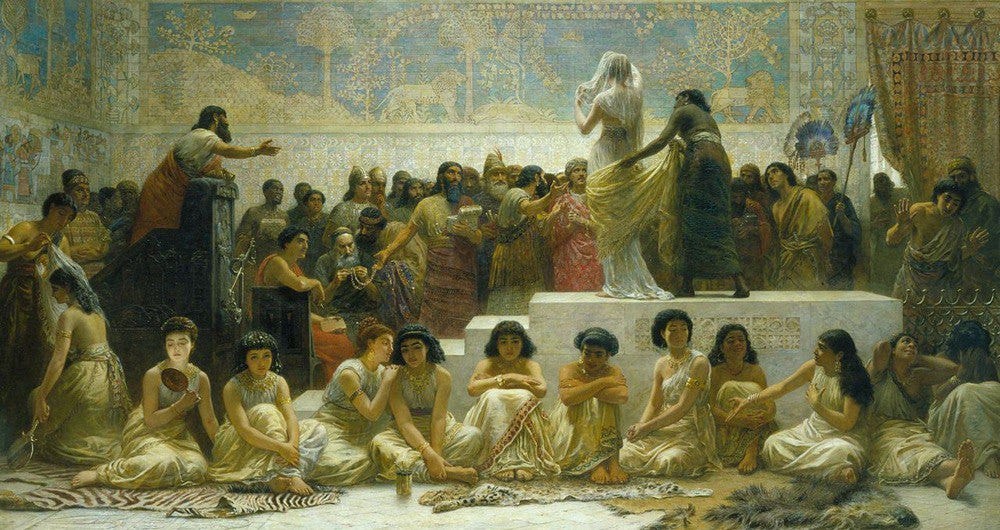
Now there are many who claim that Herodotus’s account of this Babylonian custom was not actually true — or, at the very least, embellished. But whether or not his account is accurate, the fact remains that Israelites (including John) definitely believed that it was true of Babylon. Yes, in the same way that the chaos of “The Tower of Babel” (confusion) proceeded from Babylon, so also this deplorable practise of mandatory prostitution (so-called “sacred prostitution”) was considered to have appropriately proceeded from this place of depravity and chaos. Yes, this was just one more reason of why Babylon had been singled out for what Israel was not supposed to be.
And so, when John described in Revelation many of his own fellow “Jews” — that is, all of Jerusalem, in fact — as “the whore of Babylon”, this would have been a very cutting and insulting description of the state of play in Jersualem. And famously, John would go on to warn, then, of the impending demise that was coming to Jerusalem (at the hands of the Romans).
For John, this impending doom (which actually did come to pass in year AD70, as also Jesus predicted) would be the expression of the wrath of this Divine Jealous lover—Yahweh, against a people, a city, and a temple who had broken their spiritual covenant of purity.
Thus, as had happened in the distant past, Jerusalem — this “whore of Babylon” — would be crushed by their own geopolitical neighbors once again. Yahweh—the scorned lover who was unique among the gods to actually care about his own people and wanted to be “near them when they prayed” — would be devastating in his vengeance against those who had “whored out” themselves and their principles in exchange for greater security and prestige within their political arrangement.
True to what you say
There are many who think that the fall of Jerusalem in AD70 had happened because the Jews did not accept Jesus as “Messiah” (i.e. because they didn’t become “Christians” or something). Maybe a surprise to many, this is, in fact, not the case. This God, Yahweh, could be downright terrifying. But he was famously marvelled at in ancient times for also being gracious and kind. And so, if, as an ancient person, you did not want to enter into covenant with him, you would certainly not be punished for that.
In the same way that all of Jesus of Nazareth’s threats of “hellfire” (which actually happened on earth in AD70) were intended for hyprocrites only, so also Yahweh’s original threats of destruction throughout the Torah and prophets were intended (mainly) for Israel only. That is, if they were not faithful to their covenant, their neighbors would be to them a “vital villain” sent by their own God as punishment. In other words, if you wanted to escape Yahweh’s wrath entirely and not even risk making a mistake, you could simply not enter into covenant to begin with.
Just as Ananias and Sapphira were not punished for being rich—rather, for being disingenuous — so also Israel was punished by this passionate God for not being sincere.
The truth is, Yahweh (or Jesus) is not out to get everyone (send people to “hell”) just because they don’t believe. Most of the warnings throughout the Bible were aimed at hypocrites. And so we would all do well to simply ask ourselves what we really believe and value — and maybe give ourselves some room (and time) to be honest if we don’t really live according to what we actually say we do.
Learn more about the grand story of the Bible! Click below
